Mayflies
Order: Ephemeroptera
Family: Baetidae
Genus: Callibaetis
Indentifying
Features
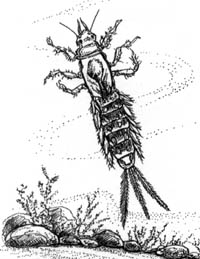
Nymphs: Distinguishing features include three fringed
tails of equal length, long antennae and large abdominal gills. Color:
pale green or mottled olive, also light to dark gray. They are capable
of rapid movement marked by quick flips of the tail propelling them
forward in 15-cm bursts. Active through the year, they are most available
to fish during their emergence swim.
Adults:
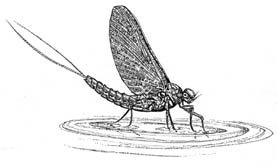
There are two stages: the dun and the sexually mature spinner. Duns
are duller in color than the glossy spinners which emerge once the duns
have shed their outer skin. Wings of both are held upright on the water
and are often likened to small sailboats.
What
to Look For
Large mating swarms of spinners congregate between midmorning and late
afternoon either over the water or over open areas nearby. Bird activity
provides good clues. Female spinners return to the water, dipping the
tips of their abdomens to the water to release their eggs, normally
without coming to rest. Bulging rise forms during emergence of duns
on the surface indicate trout are feeding on nymphs just subsurface.
Splashy rises indicate fish are feeding on adults.
Life
Cycle
The cycle itself is simple; it is the fishing which becomes complex.
Nymphs prefer the shallow near-shore zones and are rarely found deeper
than about six metres. Dense mats of aquatic vegetation are the preferred
habitat. They become most active prior to emergence, often swimming
far from cover and thus become available to fish some time before emergence.
Final emergence swim is rapid and transformation to duns is also quick,
often occurring between midmorning and early afternoon. Transformation
from dun to spinner is accomplished in about 10 hours. Males die a few
days after mating; females die after egg- laying and will be seen on
the water with outstretched wings.
 |
|
|
When
to Fish
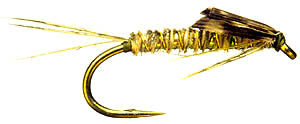
Mayfly nymph imitations are a good bet any time for probing water in
the absence of surface activity, but are most effective during late
May to mid- June when the strongest hatches occur. Depending on altitude,
this may last through July, but the most prolific hatches are normally
over by mid-July. Fish adults any time mayflies are spotted on the water.
How
to Fish
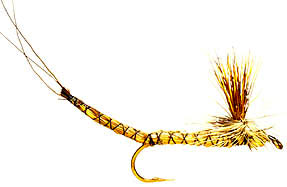
Parachute-hackled dry flies are the accepted way to go, but many fish,
and especially large, older fish, concentrate on the emerging nymphs
for long periods both before and during the emergence. Fishing duns
on the dry line is straightforward except for the intricacies of matching
the naturals as closely as possible. Emerging nymphs are best fished
on dry lines with long leaders or slow-sinking lines; retrieve is from
near bottom up towards the surface in quite rapid hand-twists or jerky
pulls of about 15 cm followed by short pauses. Nymph imitations fished
on a dry line just subsurface, twitched very slowly or dead-drifted,
can
be good at times.
 |
|
|
Fishing
Tip
A keen eye is required to keep apace of hatch developments. The odd
mayfly popping to the surface with no sign of fish activity often means
the fish are concentrating on the nymphs as they begin their surface-swim
off the bottom. Go deep. As the hatch builds, fish will follow to the
surface; use the bottom to top retrieve.
Splashy
rises call for the dry line and adult imitations and the most exciting
fishing. Trout response to spent spinners is lazy; watch for sipping-type
rises.
Be sure
to visit Fishbc.com for angling information!
Back to introduction